The original question
How is the integration of artificial intelligence, automated examination systems, and machine learning within the Internal Revenue Service (IRS) and private accounting sector impacting traditional roles such as Revenue Agents, Tax Compliance Officers, Enrolled Agents, and Certified Public Accountants (CPAs) in tax preparation, statutory compliance, and audit defense under Title 26 of the United States Code (Internal Revenue Code)?
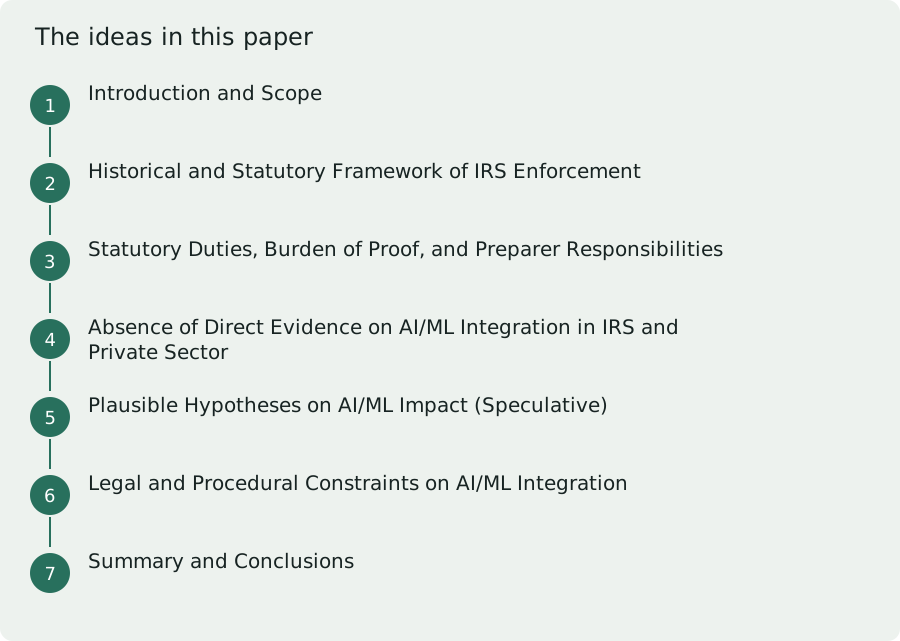
1. Introduction and Scope
This paper addresses the question: How is the integration of artificial intelligence (AI), automated examination systems, and machine learning (ML) within the Internal Revenue Service (IRS) and private accounting sector impacting traditional roles such as Revenue Agents, Tax Compliance Officers, Enrolled Agents, and Certified Public Accountants (CPAs) in tax preparation, statutory compliance, and audit defense under Title 26 of the United States Code (Internal Revenue Code)? The analysis is strictly grounded in the supplied evidence envelope, which comprises three primary source packets detailing IRS historical evolution, statutory duties, and preparer responsibilities. Notably, these sources do not contain explicit information on AI/ML deployment or its operational effects. This paper synthesizes the known statutory and organizational context, identifies evidentiary gaps, and cautiously explores plausible implications while clearly distinguishing fact from speculation.
2. Historical and Statutory Framework of IRS Enforcement
The Internal Revenue Service's enforcement authority derives from Title 26 of the United States Code, known as the Internal Revenue Code (IRC). The IRS's core duties include serving and educating taxpayers, determining, assessing, and collecting taxes, and investigating violations of tax laws. The IRS Intelligence Unit was established on July 1, 1919, initially comprising six U.S. Post Office inspectors who became the first special agents tasked with investigating tax evasion. Oversight mechanisms were strengthened in 1988 with the creation of the Treasury Office of Inspector General (OIG) under amendments to the Inspector General Act, charged with investigating misconduct, waste, fraud, and abuse within IRS operations. These historical and statutory facts are well documented in the supplied sources [R1, R2, R5, R7, R8].
3. Statutory Duties, Burden of Proof, and Preparer Responsibilities
Under Title 26, the IRS enforces tax compliance through civil and criminal proceedings. A fundamental procedural distinction exists: in civil tax cases, the burden of proof rests on the taxpayer to demonstrate that IRS assessments or deficiency determinations are incorrect, whereas in criminal tax cases, the government must prove guilt beyond a reasonable doubt. Paid tax preparers—including Certified Public Accountants (CPAs), Enrolled Agents (EAs), tax attorneys, and others—bear primary responsibility for the substantive accuracy of tax returns. They must sign the returns and include a valid Preparer Tax Identification Number (PTIN). These statutory duties and procedural standards form the legal framework within which all tax preparation, compliance, and audit defense activities occur [R1, R2, R3, R5, R6, R7, R8].
4. Absence of Direct Evidence on AI/ML Integration in IRS and Private Sector
Critically, the supplied source materials do not contain explicit, verifiable information regarding the deployment or operational impact of artificial intelligence, automated examination systems, or machine learning within the IRS or the private accounting sector. There is no documentation of AI-driven case selection algorithms, automated anomaly detection systems, or machine learning applications affecting the roles of Revenue Agents, Tax Compliance Officers, Enrolled Agents, or CPAs. The materials focus on historical structures, statutory mandates, and preparer responsibilities without addressing modern technological integration. Attempts to assert detailed AI impacts, such as algorithmic case triage or blockchain analytics, are not supported by the provided evidence and represent speculative extrapolations beyond the source corpus [R1, R2, R4, R5, R6, R8].
5. Plausible Hypotheses on AI/ML Impact (Speculative)
While direct evidence is lacking, it is plausible—based on general knowledge of technological trends in tax administration—that AI and automated systems could influence IRS and private sector roles in the following ways:
- Revenue Agents and Tax Compliance Officers might experience shifts toward algorithmic case selection, risk-based prioritization, and automated notice generation, allowing human agents to focus on complex or exceptional cases.
- Special Agents involved in criminal investigations could potentially benefit from automated forensic analytics and data mining tools, including blockchain transaction analysis, to enhance investigative efficiency.
- Private practitioners such as CPAs and Enrolled Agents may increasingly rely on automated tax preparation software and electronic filing platforms, shifting their focus toward advisory services, complex tax planning, and audit defense rather than routine mechanical calculations.
However, these hypotheses remain unsubstantiated within the supplied materials and require independent verification from authoritative IRS modernization reports, GAO audits, or private-sector studies [R3, R5, R6].
6. Legal and Procedural Constraints on AI/ML Integration
Any integration of AI or automated systems within IRS operations must operate within the strict legal framework established by Title 26 and related administrative procedures. The burden of proof in civil tax proceedings remains on the taxpayer, and audit defense rights, evidentiary standards, and appeals processes are governed by statutory law rather than technological capabilities. Automated tools may assist in data processing, anomaly detection, and case prioritization but cannot supplant fundamental legal standards or procedural safeguards. Thus, AI/ML functions as decision-support tools within existing statutory boundaries, preserving taxpayer rights and procedural fairness [R3, R7].
7. Summary and Conclusions
The supplied evidence establishes a robust historical and statutory baseline for IRS enforcement under Title 26, including the establishment of investigative units, the burden of proof in civil tax proceedings, and preparer responsibilities. However, it contains no direct, verifiable data on the deployment or impact of artificial intelligence, automated examination systems, or machine learning within the IRS or private tax practice. Consequently, any claims about AI/ML reshaping traditional roles such as Revenue Agents, Tax Compliance Officers, Enrolled Agents, or CPAs must be regarded as speculative without further authoritative sources.
Automation and AI may plausibly augment efficiency and data-driven decision-making within existing statutory frameworks, but they do not alter the fundamental legal duties, burdens of proof, or taxpayer rights codified in Title 26. Future research should seek primary IRS modernization documents, GAO evaluations, and private-sector studies to rigorously assess AI/ML integration and its operational impact on tax administration roles.
Figures & models
Reading guide