The original question
How do the policy proposals in the Heritage Foundation's 'Mandate for Leadership: The Conservative Promise' (Project 2025)—specifically regarding the Unitary Executive Theory, Schedule F civil service reclassification under 5 U.S.C. § 7511, and the centralization of regulatory authority—contrast with established democratic governance principles, the Civil Service Reform Act (CSRA) of 1978, and Democratic Party platforms regarding administrative state independence and the separation of powers under Articles I and II of the United States Constitution?
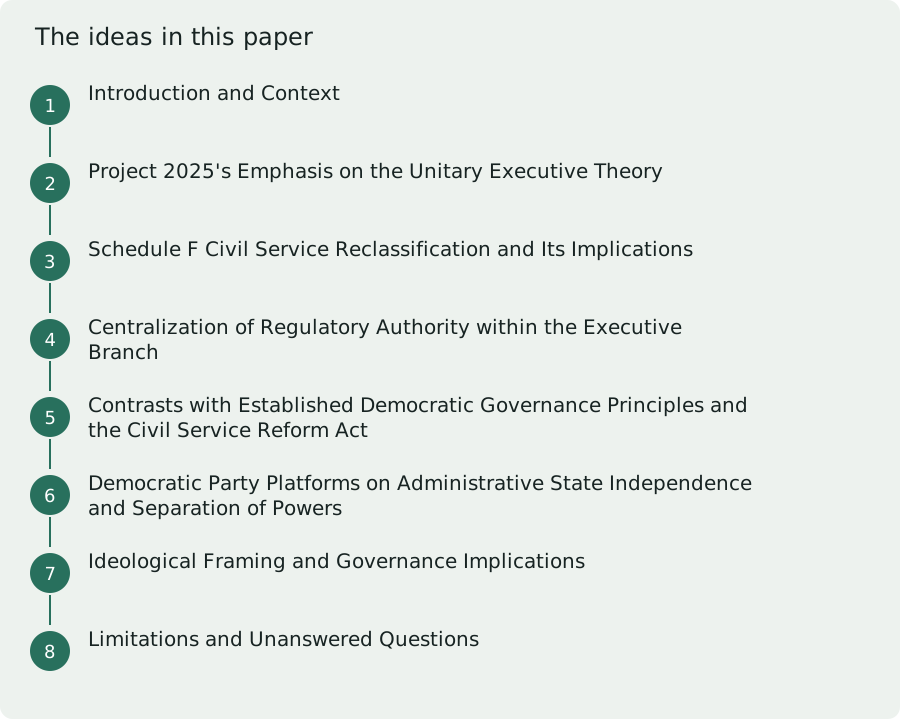
Introduction and Context
The Heritage Foundation's 'Mandate for Leadership: The Conservative Promise' (Project 2025) is a comprehensive conservative policy proposal aimed at reshaping federal governance to restore what it terms the Republic's "original moorings" and to counteract what it describes as a politicized and weaponized administrative state (C1E2, C1E9). The document emphasizes the importance of presidential control over the executive branch, advocating reforms to federal agencies, civil service personnel, and regulatory processes to align them with a conservative agenda (C46E1, C46E2). This paper examines Project 2025's key proposals related to the Unitary Executive Theory, Schedule F civil service reclassification, and centralization of regulatory authority, contrasting them with established democratic governance principles, the Civil Service Reform Act (CSRA) of 1978, and Democratic Party platforms concerning administrative independence and separation of powers under the U.S. Constitution.
Project 2025's Emphasis on the Unitary Executive Theory
Project 2025 strongly endorses the Unitary Executive Theory, which holds that all federal executive power is vested in the President under Article II of the Constitution, and that the President should have direct and comprehensive control over departments and agencies (C2E1, C5E1). The document asserts that "it is the President's agenda that should matter to the departments and agencies, not their own" (C2E1). It calls for political appointees to implement the President's agenda rather than allowing autonomous bureaucrats or "non-partisan experts" to exercise independent authority (C3E3). The Office of White House Counsel is described as a "first line of defense" to protect presidential powers against encroachments by Congress, the judiciary, and administrative agencies (C3E4). The document further advocates for the President's direct supervision of the bureaucracy, including elevating the Director of the Office of Personnel Management (OPM) to Cabinet-level status (C6E7). This approach reflects a maximalist interpretation of executive power, seeking to reduce agency independence and increase political accountability to the President (C2E5, C29E5).
Schedule F Civil Service Reclassification and Its Implications
A central proposal in Project 2025 is the reclassification of many federal civil service positions under Schedule F, authorized by 5 U.S.C. § 7511, which would exempt these positions from traditional merit-based protections and allow easier removal of career civil servants who resist the President's agenda (C2E3, C27E1, C34E1). The document criticizes "byzantine personnel rules" that protect bureaucrats and thwart presidential appointees (C2E3). It calls for replacing career Senior Executive Service (SES) officials with political appointees and increasing the number of Schedule C/political appointees who supervise career staff (C9E8, C34E1, C35E3). This reclassification challenges the merit system established by the Civil Service Reform Act of 1978, which aims to ensure a professional, nonpartisan civil service insulated from political interference (X10, X11, X15). The CSRA provides procedural safeguards and limits on political activities by federal employees, designed to prevent politicization and maintain administrative neutrality (X10, X11). Project 2025's proposals raise legal and constitutional questions about compatibility with the CSRA and the principles of a merit-based civil service, though the document does not provide detailed legal analysis on these issues.
Centralization of Regulatory Authority within the Executive Branch
Project 2025 advocates for consolidating regulatory and budgetary control within the executive branch, particularly under the Office of Management and Budget (OMB), the White House Office, and political appointees (C2E5, C9E7, C14E1). It criticizes the diffusion of authority across agency components and calls for department-wide policies aligned with the President's priorities (C9E7). The document proposes limiting agency autonomy by centralizing communication and enforcement authority, disbanding advisory boards, and increasing political oversight of legal offices (C10E1, C9E8). It also recommends restructuring or dismantling federal agencies such as the Department of Homeland Security (DHS), Environmental Protection Agency (EPA), Department of Energy (DOE), and others to enhance presidential control and reduce bureaucratic independence (C8E1, C22E4, C24E1). These proposals reflect a desire to reduce the administrative state's perceived overreach and politicization by strengthening executive oversight. However, the document does not extensively discuss constitutional limits, legislative or judicial checks, or the potential risks of such centralization.
Contrasts with Established Democratic Governance Principles and the Civil Service Reform Act
Established democratic governance principles emphasize the separation of powers among the legislative, executive, and judicial branches as articulated in Articles I, II, and III of the U.S. Constitution, with a system of checks and balances to prevent concentration of power (X1, X4, X5, X23). The legislative branch enacts laws, the executive enforces them, and the judiciary interprets them, maintaining institutional independence and accountability (X3, X4). The CSRA of 1978 codifies merit-based protections for federal employees, limits political interference, and provides procedural safeguards to ensure a professional and nonpartisan civil service (X10, X11, X15). Schedule F reclassification, as proposed by Project 2025, would exempt positions from these protections, potentially undermining the merit system and increasing politicization (C2E3, C4E5, C34E1). Furthermore, Project 2025's emphasis on executive dominance and centralization challenges the traditional balance of powers by expanding presidential control at the expense of legislative and judicial oversight (C2E6, C18E1, C29E5, C41E4). The document acknowledges legislative primacy in lawmaking but seeks to expand executive control over administrative agencies, creating tension with democratic governance norms (C2E7, C18E7).
Democratic Party Platforms on Administrative State Independence and Separation of Powers
While direct excerpts from Democratic Party platforms on Schedule F or the Unitary Executive Theory are limited in the supplied materials, general political analyses indicate that Democratic platforms typically support administrative state independence, regulatory agency autonomy, and adherence to separation of powers (X19, X21). The Democratic Party historically emphasizes checks on executive power, the importance of an independent civil service, and the role of regulatory agencies in protecting public interests. This contrasts with Project 2025's focus on executive centralization, politicization of the civil service, and reduction of agency autonomy. The Heritage Foundation critiques the administrative state as unaccountable and ideologically biased, whereas Democratic platforms tend to defend the administrative state's role in governance and regulatory oversight.
Ideological Framing and Governance Implications
Project 2025 frames the current administrative state as a "behemoth" weaponized against conservative values and freedom, advocating for reforms to restore constitutional governance as interpreted by conservative principles (C1E2, C1E9, C31E1, C46E4). The proposals emphasize ideological alignment of federal agencies with conservative values, including rolling back diversity, equity, and inclusion initiatives, reshaping agency cultures, and increasing political appointee influence (C12E5, C14E7, C31E1). The document calls for dismantling or restructuring agencies such as DHS, EPA, DOE, and HHS to enhance presidential control and reduce bureaucratic independence (C8E1, C22E4, C24E1). These reforms challenge traditional norms of civil service neutrality and administrative independence, raising concerns about politicization, loss of nonpartisan expertise, and potential erosion of institutional knowledge. The document does not provide empirical evidence on the effects of these changes or detailed legal analysis of their constitutional implications.
Limitations and Unanswered Questions
The analysis is limited by the nature of the Heritage Foundation's Project 2025 document as a policy advocacy text lacking balanced legal or constitutional analysis. It does not engage deeply with judicial precedents, constitutional scholarship, or counterarguments defending administrative state independence and civil service protections. Direct Democratic Party platform references are sparse, relying on general political analyses. The legal compatibility of Schedule F reclassification with the CSRA and constitutional separation of powers remains unexamined in detail. The practical implications, risks, and governance outcomes of centralizing regulatory authority under the executive branch are not comprehensively addressed. The role of the judiciary and Congress in checking potential executive overreach is not discussed. Unanswered questions include how courts have ruled on Schedule F's constitutionality, detailed Democratic positions on these issues, empirical effects of regulatory centralization, and the impact on nonpartisan expertise within the federal bureaucracy.
Input report sections: R1
Figures & models
Reading guide